My wife said something two years ago that I'm still thinking about.
We were in the kitchen. The kids were in bed. It was one of those rare evenings where neither of us was working, neither of us was on a phone, and the flat was quiet enough to hear the tram outside.
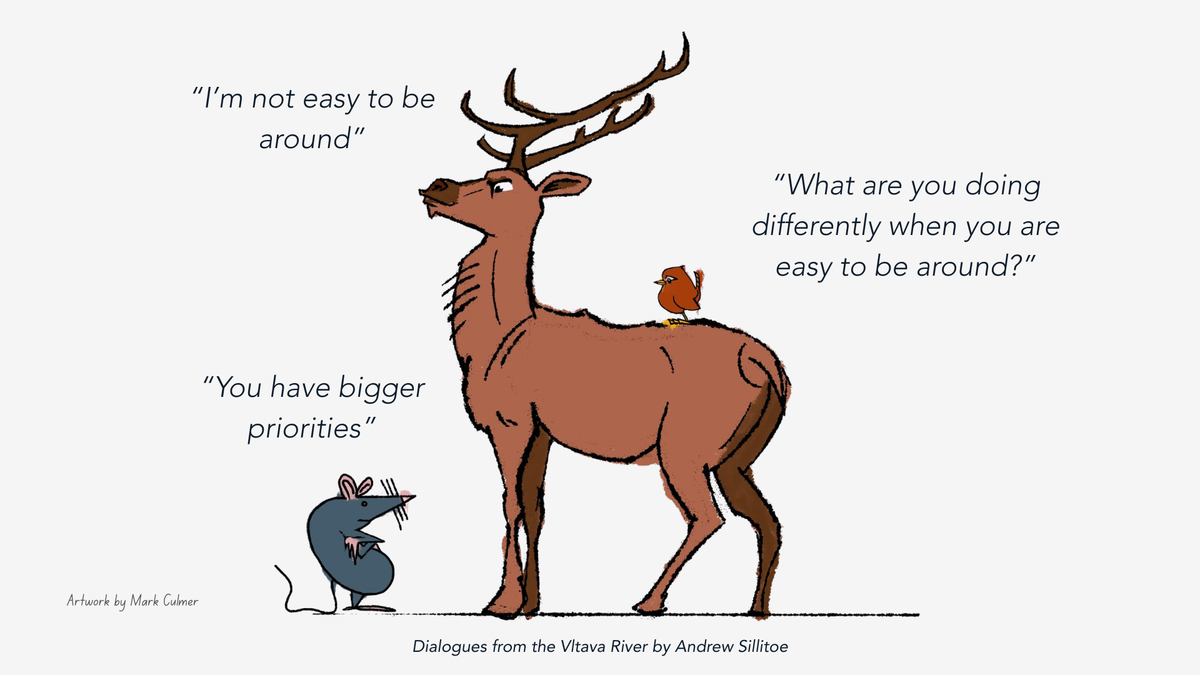
She said: "You're easier to be around than you used to be."
That's it. That was the whole sentence.
She didn't say it like a compliment. She said it like an observation. The way you'd say "it's warmer today." Just noticing.
I didn't know what to do with it. The Rat wanted to turn it into a project. Easier how? Since when? What was I doing before? What exactly changed? Can I measure it? Can I make sure I don't go back?
But I didn't say any of that. I just said, "Thank you."
And we stood there for a minute, not saying anything, which is something we couldn't have done three years ago. Three years ago, silence between us felt like a problem to solve. Now it felt like a room we could both be in.
I tell this story because it's the kind of result that doesn't fit on a landing page.
No one hires a coach because they want their wife to say they're easier to be around. No one books a workshop because they want to stand in a quiet kitchen and feel okay about the silence. These aren't KPIs. They can't be measured in a quarterly review.
But they're the thing that actually matters.
I spent years chasing the professional results. The clients. The revenue. The reputation. The feedback forms with high scores. And all of it was real, and all of it was fine, and none of it touched the thing that was actually broken.
The thing that was actually broken was that the people who loved me were getting the worst version of me.
Not the incompetent version. The defended version. The version that came home with nothing left. The version that was so good at performing presence in a meeting that he had no presence left for the kitchen.
Prague didn't fix that. The river didn't fix that. What fixed it — and I use the word carefully because it's not really fixed, it's practised — was learning to hear the Rat before it ran the evening.
I'd come home and the Rat would still be on. But not in the way you'd expect. I wasn't the dad running bedtime like a military operation. I was the dad who wasn't there at all.
My wife did it. Bath, teeth, stories, lights out. Every night. Because by the time I walked through the door, I'd already given everything to the work. I was physically home but I was gone. On the sofa. On my phone. In my head. Anywhere but in the room where my children were asking for me.
I told myself she was better at it. I told myself the kids preferred her at bedtime. I told myself I'd been working all day and I needed to decompress.
The Rat is very good at making absence sound reasonable.
My wife didn't need me to manage bedtime. She needed me to show up for it. My children didn't need a perfect father. They needed a present one.
Learning to switch from the Rat to the River at the front door is the hardest transition of my day. Harder than any client session. Harder than any keynote. Because the Rat has been running for ten hours and it doesn't know the threat is over.
Some evenings I manage it. I put the phone in the drawer. I sit on the floor with my youngest. I let the evening be slow and imperfect and unmanaged. Those are the evenings my wife notices.
Some evenings I don't manage it. I bring the Rat home. I'm short with the kids. I half-listen to my wife while checking emails. I go to bed feeling like I failed at the one thing that actually matters.
The difference between the two isn't willpower. It's noticing. Can I hear the Rat at the front door? Can I feel it still scanning? And can I let it rest — not by fighting it, but by recognising it's done its job for the day?
"You're easier to be around than you used to be."
That sentence means more to me than any testimonial, any client result, any professional achievement of the last seventeen years.
Because it means the work is working. Not the work I do for others. The work I do on myself. The slow, unglamorous, daily practice of hearing the voice that protects me and choosing — one evening at a time — to let it rest.
If you're an expat in Prague building something ambitious, the question isn't whether you're succeeding at work. You probably are. The question is what version of you walks through the door at the end of the day.
Your partner knows the answer. Your children know the answer. The only one who might not know is you.
I'm Andrew Sillitoe. I help leaders have better conversations. If this resonated, you can find more at andrewsillitoe.com.